- SAP APO is the advanced planning system many companies connected to their ECC to plan demand, supply, production, delivery promises and transportation.
- It is part of SAP SCM 7.0, whose mainstream maintenance ends on December 31, 2027. It can be extended, for a fee, through 2030.
- SAP no longer develops it: each piece has a successor (IBP or S/4HANA), and migration is not automatic.
- If you depend on APO today, the question is no longer “whether” to migrate but to what and in which order.
What APO does, module by module
Think of APO as the “planning brain” that sits next to your ERP: the ERP executes (orders, production, inventory) and APO decides what, how much, where and when. They talk through an interface called CIF, and APO keeps its calculations in memory (liveCache) to plan fast.
Statistical and collaborative forecasts: how much you’ll sell by product, customer and period.
How to supply that demand across plants, DCs and suppliers, with mid-term capacities.
Sequencing and fine scheduling of orders on plant lines and resources.
Confirms orders against real availability, substitutions and allocations.
Plans and optimizes shipments considering vehicle capacity.
What replaces each module
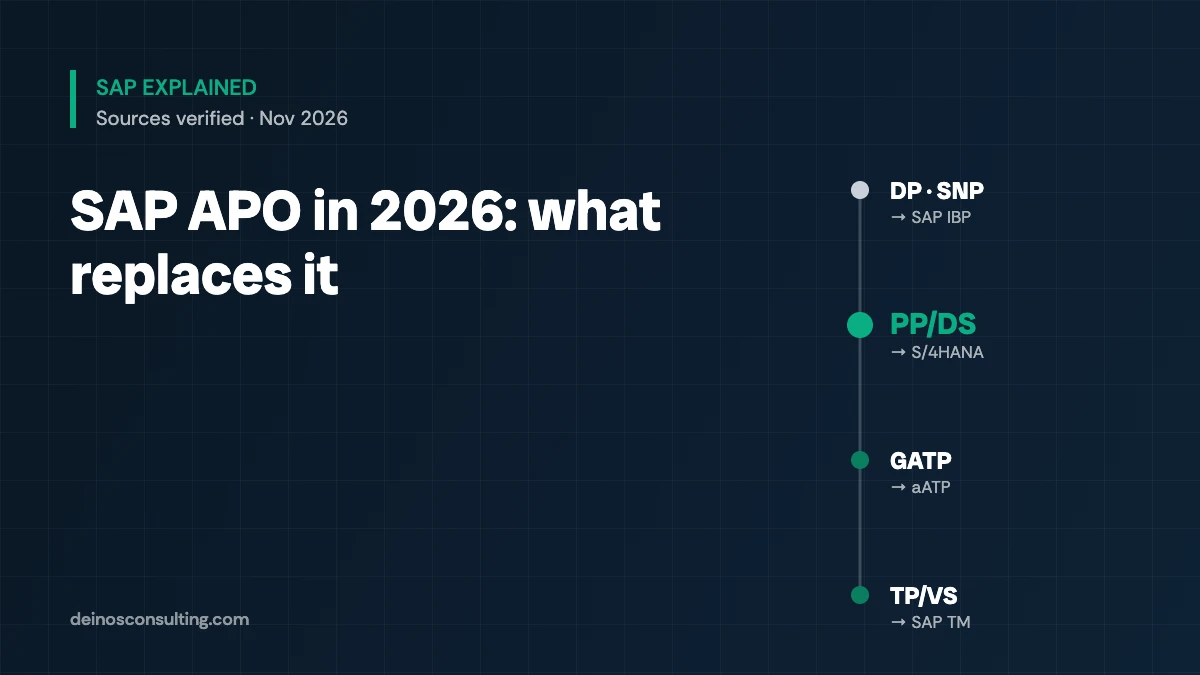
| APO module | SAP successor | What you should know |
|---|---|---|
| DP | → SAP IBP (demand) | IBP is cloud-based with a different data model: you redesign, you don’t copy. |
| SNP | → SAP IBP (supply) | Network planning stays in IBP; plant-level planning goes to S/4HANA. |
| PP/DS | → PP/DS inside S/4HANA | Available in S/4HANA since release 1709. Migration becomes part of the ERP project. |
| GATP | → aATP in S/4HANA | aATP was built from scratch; CTP-type scenarios move to “Supply creation-Based Confirmation”, which needs aATP and PP/DS. |
| TP/VS | → SAP Transportation Management | SAP TM evolved from TP/VS and is now built into S/4HANA. |
Key point: SAP has said for years that APO configurations can’t be reused in IBP or aATP. It’s a reimplementation using what you’ve learned, not a copy-paste.
The dates that matter
Does it still make sense to run APO?
Short term, yes: if it works and your team knows it, there’s no need to switch it off overnight. But it no longer pays to invest in new functionality inside APO. The sensible move is to use it as a bridge while you design its replacement.
What it means for your Supply Chain operation
- Map your usage. Which modules you really use (many companies only use DP and SNP) and how much custom code they carry.
- Split the workstreams. Network planning (DP, SNP) goes to IBP; plant and promise (PP/DS, GATP) go with your S/4HANA project.
- Define your 2028 bridge. Extended maintenance or alternative support while you migrate.
- Use the move to simplify. Clean up parameters, forecast profiles and master data before moving them.
Related: SAP ECC and APO in 2027: what changes and your options
This article is for information only. Maintenance terms depend on your SAP contract; confirm them in SAP Note 1648480 or with your account executive.
- SAP Support – Business Suite 7 maintenance strategy
- SAP Community – Future of APO and its migration
- SAP Community – aATP Supply creation-Based Confirmation
- SAP Learning – SAP S/4HANA and Transportation Management
- LeverX – From APO PP/DS to PP/DS in S/4HANA
- SAPinsider – Support deadlines 2027, 2030 and 2033
- Arkieva – APO to IBP migration