- SAP PM (Plant Maintenance) manages maintenance of your equipment: what gets checked, when, by whom, with which spare parts and at what cost.
- In S/4HANA it is part of SAP S/4HANA Asset Management; PM logic remains the foundation.
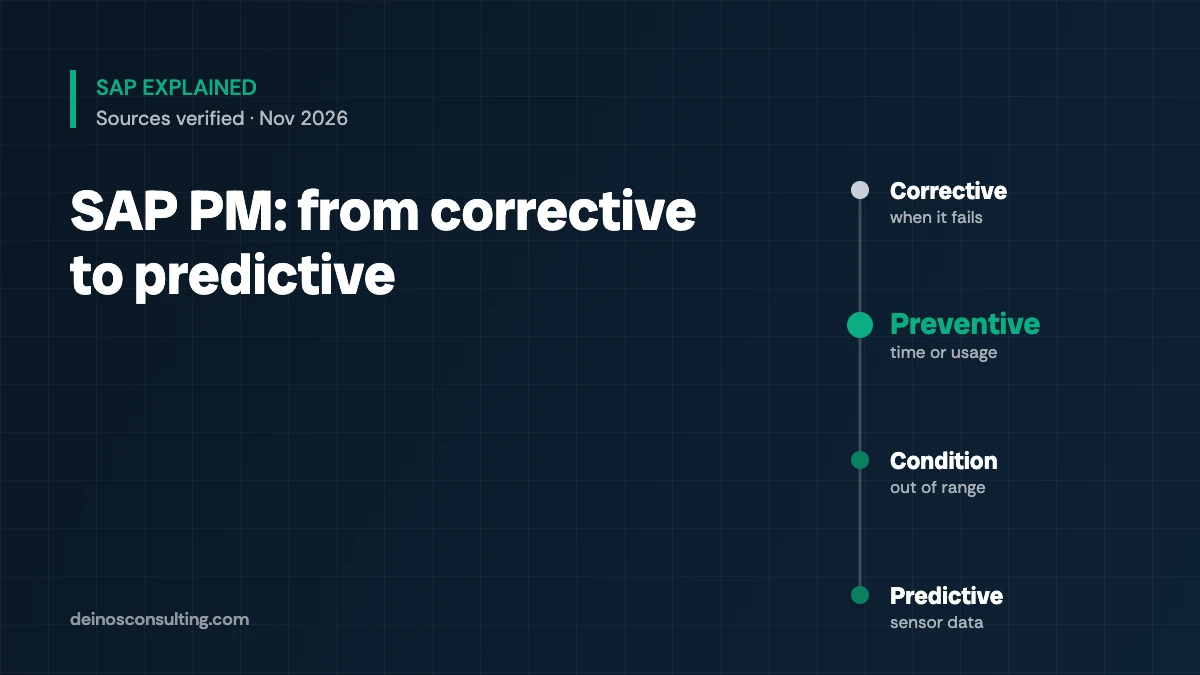
- Maintenance can be time-based, usage-based (counters), condition-based or predictive; each is set up differently.
- The real difference comes from data: well-built functional locations, equipment and task lists.
What it does, in one sentence
PM is your workshop’s logbook and planner: it knows what equipment you have and where, what is due, generates work orders, requests spare parts from the warehouse and purchasing, and records the cost of each job.
Maintenance types, explained
| Type | When it triggers | Example |
|---|---|---|
| Corrective | → When something fails and a notification is raised | A forklift stops lifting; the operator logs it and an order is created. |
| Time-based preventive | → Every set period | Check compressors every 3 months. |
| Usage-based preventive | → When a counter reading is reached | Change oil every 500 operating hours. |
| Condition-based | → When a measurement goes out of range | Motor temperature above 85 °C. |
| Predictive | → When a model anticipates failure from sensor data | Vibration showing bearing wear before it breaks. |
The objects you should know
Your plant structure: line, area, system.
Each individual asset with its history and costs.
Steps, times, spare parts and required skills.
Generates orders automatically by time or counter.
Records the failure or request.
Brings together labor, materials and actual cost.
For condition-based and predictive strategies, SAP offers cloud solutions (such as SAP Asset Performance Management) that use sensor data and each asset’s risk to decide what to maintain and when, triggering orders in S/4HANA.
What it means for your Supply Chain operation
- Fix your master data first. Without well-defined functional locations and equipment, no cost or reliability report is useful.
- Move critical equipment from corrective to preventive. Start with the assets that stop the line.
- Connect PM with warehouse and purchasing. Critical spare parts need their own inventory policy.
- Measure. Mean time between failures, mean time to repair and cost per asset tell you where to invest.
This article is for information only. Available features depend on your SAP version and licenses.