- SAP IBP (Integrated Business Planning) is SAP’s cloud Supply Chain planning solution and APO’s successor for demand and supply network planning.
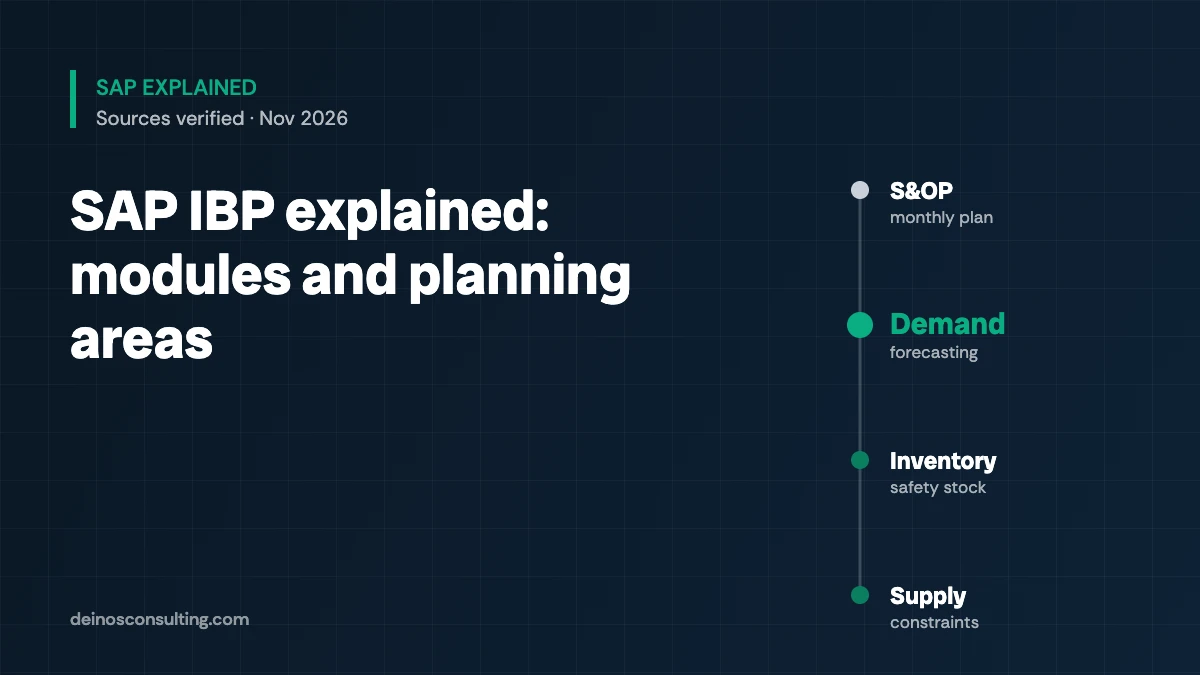
- It is made of applications you can adopt in parts: S&OP, demand, inventory, response and supply, DDMRP and Control Tower.
- Everything lives in a planning area: the model that defines what you plan, at what level and with which figures.
- It gets quarterly releases (2602, 2605, 2608…), with more and more AI and Joule.
What it is, in one sentence
If your ERP (ECC or S/4HANA) is where operations are executed, IBP is the table where sales, operations and finance sit down to agree what will be sold, produced, bought and kept in stock, with numbers everyone sees at the same time.
The concepts you need to understand
| Concept | What it is | Example |
|---|---|---|
| Planning area | → The “model” that holds everything you plan | One planning area for demand and supply across your network. |
| Key figure | → Every number that is planned or calculated | Statistical forecast, consensus demand, projected inventory. |
| Attribute | → How information is described and grouped | Product, customer, DC, family, region. |
| Planning level | → The combination of attributes and time where a figure lives | Forecast by product–customer–month; capacity by resource–week. |
| Version / scenario | → Copies of the plan to compare alternatives | “What if demand goes up 15%?” without touching the official plan. |
The IBP applications
Aligns demand, supply and finance in one monthly plan.
Statistical and machine-learning forecasting, demand sensing and history cleansing.
Calculates optimal safety stock across the network.
Supply plans with capacity constraints and allocations.
Positions strategic buffers to absorb variability.
End-to-end visibility, alerts and KPIs.
SAP provides a sample planning area (SAPIBP1) that integrates all applications and serves as a starting point. Standard integrations connect IBP with S/4HANA or ECC for master and transactional data.
What it means for your Supply Chain operation
- Start with the process, not the system. Without a monthly S&OP with clear owners, IBP just digitizes the chaos.
- Adopt in stages. Most start with demand or S&OP and then add supply or inventory.
- Get planning levels right. Planning too granular slows the model and wears planners out.
- Organize for quarterly releases. Assign someone to review and test each quarter’s new features.
Related: SAP ECC and APO in 2027: what changes and your options
This article is for information only. Available features depend on your licenses and IBP release.