- SAP S/4HANA is SAP’s current ERP: the successor to ECC, built to run only on the SAP HANA in-memory database.
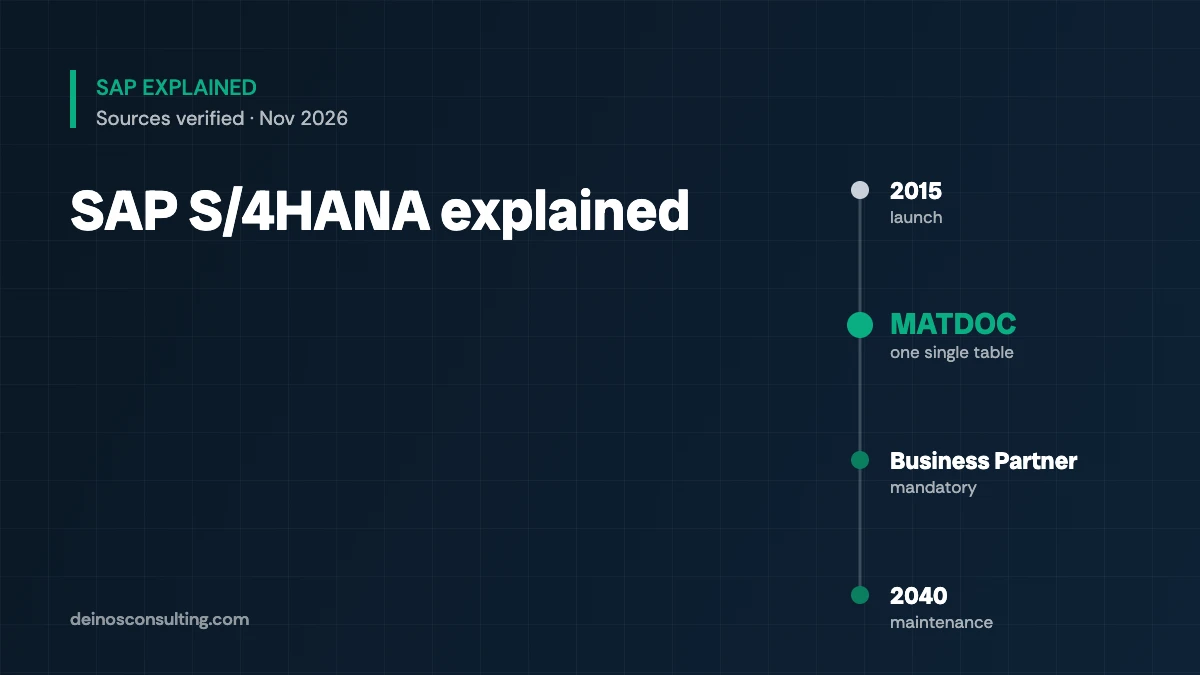
- It is not “a faster ECC”: master data, tables and key Supply Chain processes change (Business Partner, MATDOC, Material Ledger, MRP Live).
- It comes in three forms: public cloud, private cloud (RISE) or on-premise.
- SAP has committed to maintaining S/4HANA at least until 2040.
What it is, in one sentence
If ECC is a building that kept getting new floors for decades, S/4HANA is the same kind of building rebuilt on new foundations: fewer duplicate tables, in-memory calculations and a single version of the truth for logistics and finance.
What changes for Supply Chain vs. ECC
| In ECC… | In S/4HANA… | Why it matters |
|---|---|---|
| Separate customers and vendors | → Mandatory Business Partner | Master data must be converted and cleaned before migrating. |
| Material documents in MKPF/MSEG | → A single table: MATDOC | Faster inventory reporting; review custom code that read the old tables. |
| Optional Material Ledger | → Mandatory Material Ledger | Changes inventory valuation; actual costing remains optional. |
| Classic MRP | → MRP Live | Faster planning; some classic features remain only for compatibility. |
| Source list almost mandatory | → A valid info record is enough | Less master data upkeep for purchasing. |
The three ways to run it
Standard SaaS with automatic updates. Less customization, lower operating cost.
Your own system managed by SAP, with more flexibility. Follows the on-premise release cycle.
You run infrastructure and upgrades. Maximum control, maximum responsibility.
S/4HANA also embeds capabilities that used to be separate systems: EWM for warehouses, TM for transportation, PP/DS for production scheduling and aATP for delivery promises.
What it means for your Supply Chain operation
- Review your master data. Business Partner and Material Ledger force you to clean up customers, vendors and valuations.
- Inventory your custom code. Anything reading tables that disappeared must be adapted.
- Decide which embedded capabilities you’ll use. EWM, TM, PP/DS or aATP may replace systems or processes you run outside today.
- Choose the edition with operations in mind, not just cost: how much you need to customize and who will run the system.
Related: SAP ECC and APO in 2027: what changes and your options
This article is for information only. Exact changes depend on your release and SAP’s Simplification List.